
Provider names can be useful shortcuts when browsing a large slot catalogue. They may tell you where a game came from or which platform presents it. They do not, by themselves, tell you whether a title suits your device, budget or preference for clear rules. One provider can publish several games with very different paytables and controls; one platform can display games from more than one developer.
This article explains how to compare providers through the titles you can actually access. It avoids a universal “best provider” ranking. The useful evidence is visible in a game: its rules, total bet display, feature explanation, mobile controls and record of completed rounds. If you need a primer on RTP and volatility first, use our Thai slots explainer.
Distinguish a developer, platform and individual game
Casino menus often mix several kinds of names. A developer creates a title. A platform or app may present titles, handle account access or group several game categories. The title itself has the paytable and rules that apply to a round. Marketing pages sometimes use “provider” loosely for all three, which can make comparisons confusing.
When you open a catalogue, note the exact title and the name displayed inside the game. If a platform page mentions slots, live tables and other products, do not assume all of them share one set of rules. Likewise, two titles from the same developer need not share the same reel arrangement, return figure or feature frequency.
The ChokD99 slot catalogue introduces several names, while pages for Joker Slot, Live22 and Mega888 Slot describe particular platforms. Use those pages to find an area of interest. Our ChokD99 site guide maps where to find the broader account and support information. For a precise provider comparison, open the current titles and read their own information panels.
Compare paytables before comparing themes
Start with two titles and ask the same questions of each. How are paying combinations formed? Does the game use paylines, ways or clusters? Which symbols have special functions? Are displayed awards based on a line bet, total bet or coin value? Is the complete cost of a spin visible before you press the control?
A provider may use a consistent visual style across its games while varying the underlying structure. A fantasy theme and a fruit theme can also use similar mechanics despite looking unrelated. The paytable is a stronger basis for comparison than the cover art or the provider logo.
Take brief notes rather than trying to remember every rule: “Game A uses fixed lines and a simple symbol table; Game B has a grid feature with several help screens.” That describes a real difference. “Game B is luckier” does not; a few outcomes cannot establish such a claim. For a repeatable set of title-level questions, use our slot game checklist.
Look closely at features and optional controls
Feature names are not standardized across every developer. A wild symbol may substitute for some symbols but not others. A scatter may trigger a feature, pay on its own or both. Cascading reels may replace winning symbols under title-specific rules. Read how the feature begins, what it changes, and when it ends.
Optional controls deserve the same attention. Some titles offer autoplay, a faster animation mode, an ante setting or a direct feature purchase. Those controls can change the pace or the amount spent. Confirm their price and stop conditions before using them. A quick animation does not improve the underlying result of an independent round; it mainly changes how the round is displayed and how quickly the next one can begin.
If a feature is shown prominently in promotional artwork, check whether the actual game rules explain it. A picture of a bonus round does not say how often it will occur in your session. A comparison should describe the rules, not promise a feature or a payout.
Compare the total bet display across interfaces
One of the most practical differences between providers is where they display the stake. A game may show a single total-bet number; another may require you to combine coin value, lines and a multiplier. On mobile, the same controls may move behind a menu.
Before starting a paid round, adjust the stake and observe the total cost. Return to the main screen and check that the chosen amount remains visible. If a tap on an adjacent button could change the stake or activate an optional feature, that matters to usability. The interface should make the cost of the next action clear without requiring a calculation from memory.
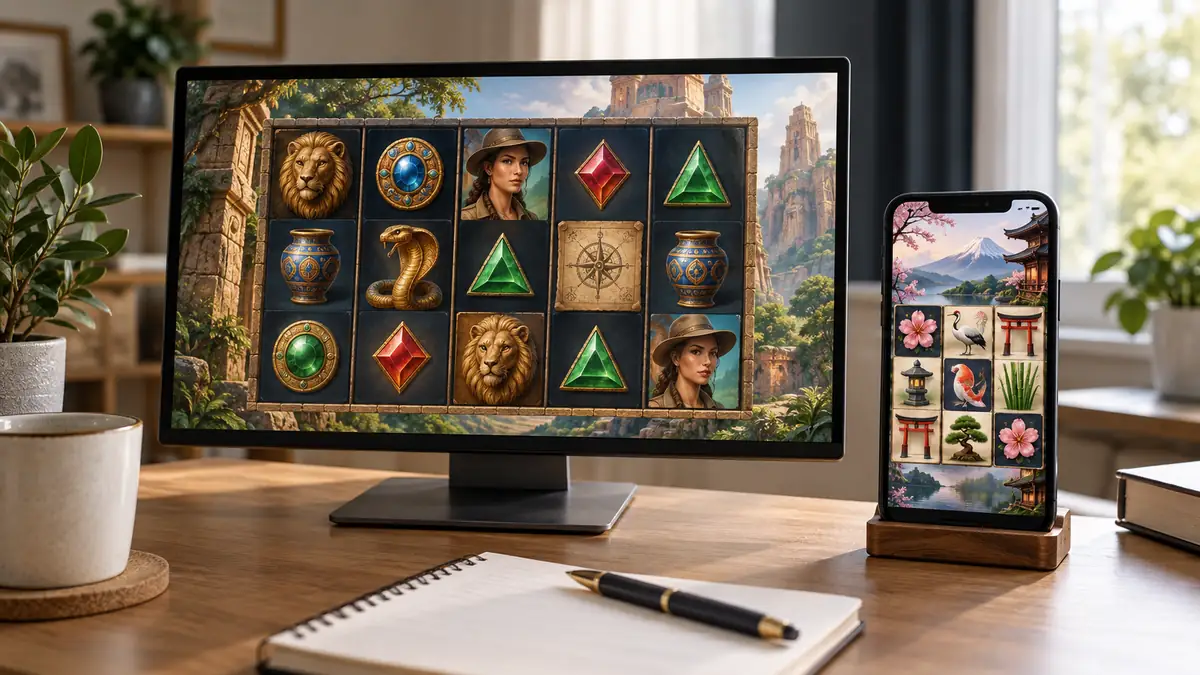
Use the same device for your comparison. A title that feels straightforward on desktop may be cramped on a phone, while a portrait-first layout may be more legible on mobile. Test the paytable, bet controls and game history, not only the loading screen.
Mobile design is more than screen size
A useful mobile slot interface keeps key information within reach: total bet, balance, rules, active feature state and a way to review rounds. Check whether the game rotates cleanly, whether text remains readable in portrait or landscape orientation, and whether a system notification covers an important control.
Connection interruptions are another practical test. If the app or browser closes mid-round, the animation may not tell you how the round settled. Find the history or transaction record and note the round identifier if one is available. Ask support to investigate a specific round rather than inferring the result from a frozen screen.
Our mobile casino guide covers account and payment usability more broadly. For provider comparisons, keep the focus on the game interface itself and repeat the same checks for each title.
Treat RTP information carefully
Where a game publishes an RTP, check that the figure belongs to the exact title and version available to you. A review of a differently configured version may not describe what you see. RTP is a theoretical long-run measure under specified conditions, not a forecast for one session. It cannot establish that one provider is “due” to pay after another has not.
Volatility describes how payouts may be distributed, but a label alone is not a quality score. A provider may offer titles with different volatility profiles. If the information is not shown in the game, do not invent a figure or copy one from an unrelated page. Record “not displayed” and decide whether that missing information matters to your comparison.
Neither a provider name nor a percentage removes the risk of loss. Set a time and spending boundary before using any title. ChokD99’s responsible gaming page describes account controls and support routes for taking a break.
Keep promotions separate from provider comparisons
A site promotion may include some providers or titles and exclude others. The provider’s game rules do not decide whether a promotion applies; the current offer terms do. Check eligibility, game contribution, maximum stake and expiry for the exact offer. If the wording groups titles under a platform name, ask support whether the specific game you selected is included.
This separation prevents an attractive game from being mistaken for an eligible game. It also makes comparisons fairer: first decide whether the title’s rules and interface make sense to you, then examine any offer as a separate set of conditions.
A repeatable two-game comparison
Open two titles on the same device. Record each exact name, provider or platform label, total bet, paytable structure, optional controls, rule-screen readability and round-history access. Note any information you could not find. Then compare the observations without turning them into a prediction.
The stronger choice is the title whose rules and costs you understand and whose controls work reliably on your device. A provider can help you discover games you might like, but the individual title determines the actual experience. Compare what is on the screen today, not a blanket claim about which logo is “best.”