
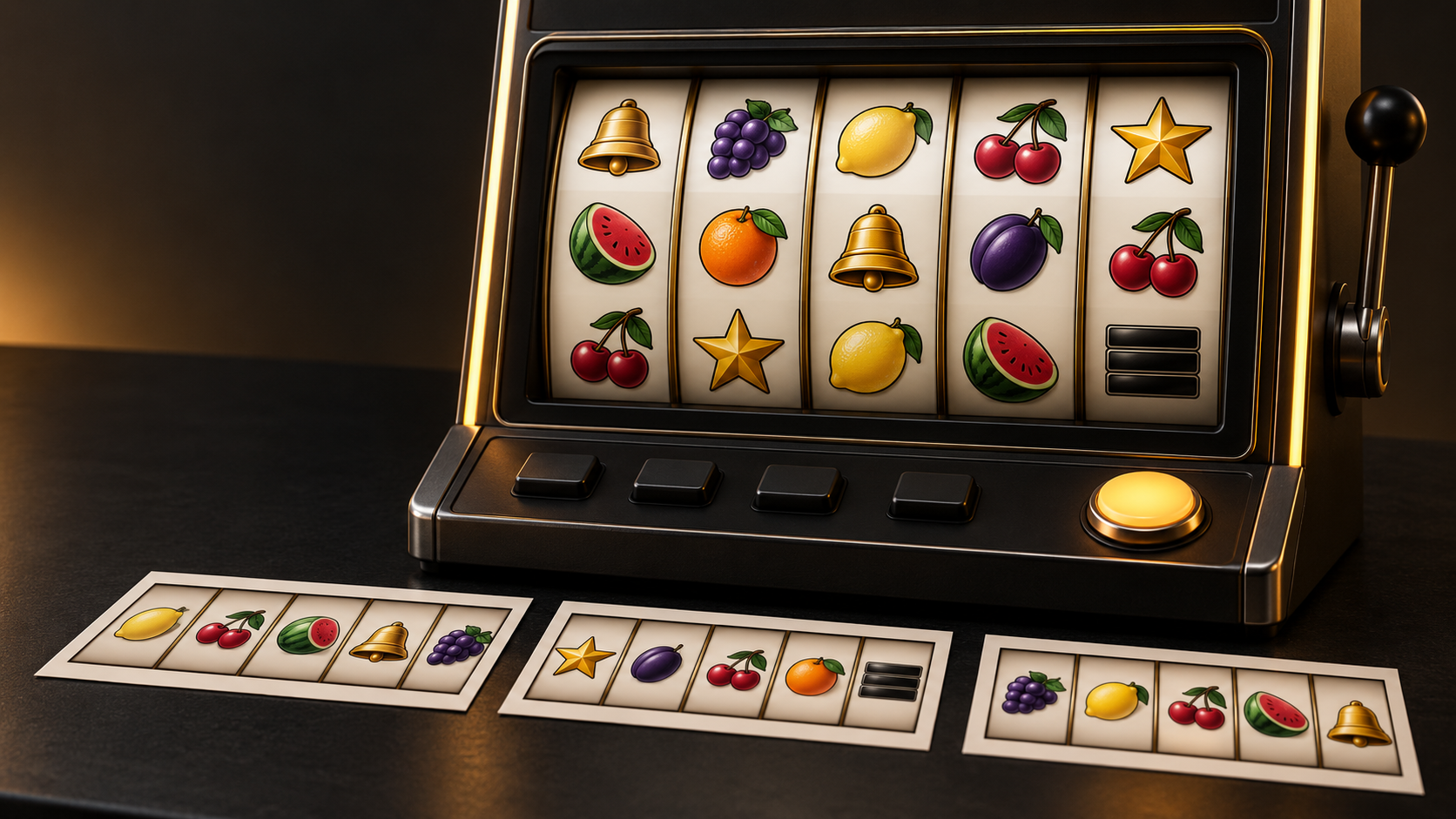
A slot can produce several losing rounds followed by a large payout—or several payouts followed by a long losing streak. Once a pattern appears on the screen, it is natural to wonder whether it provides information about the next spin.
So, are slot spins independent?
For a conventional slot using independently generated base-game results, earlier wins and losses do not make a particular result more likely on the next spin. A game does not normally owe the player a win because it has produced several losses.
However, some bonus features retain information between actions. Understanding the difference between independent spins and a feature with a continuing state helps you interpret slot results more accurately.
What Does an Independent Slot Spin Mean?
Two results are independent when the first result does not change the probability of the second.
Consider a simplified example where an event has a one-in-ten probability on every independent attempt. If the event does not occur during the first nine attempts, its probability on the tenth attempt remains one in ten.
The earlier failures do not create a debt that the next attempt must repay.
This is only a probability example. It does not describe the actual odds of a particular slot feature or prize. Those probabilities depend on the game’s mathematical design.
Independence also does not mean that every possible result has the same probability. A slot can produce common low-value combinations and much rarer high-value combinations while its base-game rounds remain independent.
How Does a Slot RNG Work?
An RNG, or random number generator, produces values that the game uses to determine an outcome. The slot’s internal rules map those values to reel positions, symbols or another defined result.
The visible reels and animations then present that result to the player.
This creates two separate layers:
- The RNG produces the underlying values.
- The game applies its rules and displays the corresponding outcome.
The symbols displayed on a slot do not necessarily have equal probabilities. A rare symbol may appear less frequently than an ordinary symbol even if both occupy the same amount of space on the screen.
The United Kingdom Gambling Commission’s technical standards provide a useful regulatory example. Within their scope, random game outcomes must be acceptably random and unpredictable, while adaptive behaviour that changes probabilities during play is not permitted. The standards still allow properly described bonus features to use different rules after qualifying random events. genui{“citation”:{“ref”:”turn2view0″}}
This standard does not verify any individual game on ChokD99. It illustrates the difference between random generation, outcome mapping and a bonus feature operating under disclosed rules.
Does the Spinning Animation Determine the Result?
The spinning reels are primarily the game’s visual presentation. Watching them does not reveal enough information to calculate what will happen next.
A symbol stopping close to a payline can feel significant, particularly when it would have completed a large combination. However, visual closeness does not mean that the missing symbol has become more likely to appear during the next round.
A near miss is still a non-winning result under the paytable.
You should determine wins by checking the completed reel layout and the game’s rules—not by judging how close the animation appeared to be.
If you are unfamiliar with how winning combinations are evaluated, read our guide to paylines, ways and cluster pays.
Are Slots Hot After Several Wins?
Calling a slot “hot” usually means it has recently produced several winning rounds or one unusually large payout.
That description tells you what happened previously. It does not establish what will happen next.
A short winning sequence can occur naturally in a random game. Continuing to play because the game appears hot does not mean that the favourable sequence will continue.
Videos and screenshots can make hot-slot claims especially persuasive. However, they frequently omit important information such as:
- The number of rounds played
- The player’s total stakes
- Earlier losing sessions
- The game configuration
- Whether a bonus was purchased
- The total amount returned relative to the amount spent
A selected winning clip is evidence that a win occurred. It is not evidence that another player can predict or reproduce it.
Is a Slot Due to Pay After a Losing Streak?
No ordinary losing streak guarantees that a slot is due to produce a winning result.
Believing that a win becomes more likely because several losses have already occurred is known as the gambler’s fallacy. It treats random variation as though the game must balance every individual session.
Suppose a player begins with 1,000 units and loses 300 units. A later return of 100 units does not represent the game repaying part of a mathematical debt. It is simply another result added to the session balance.
Increasing the next stake because recovery feels due exposes more money without proving that a favourable result has become more likely.
A slot’s theoretical return percentage also does not create a recovery schedule. RTP is a long-run mathematical measure based on a large volume of play. It is not a promise that a particular player or session will receive the stated percentage back.
When Can the Current Game State Matter?
Some slot features retain information during a defined sequence. In these situations, the current feature state can affect what happens next.
Examples may include:
- A multiplier that increases during consecutive cascades
- Sticky wilds that remain for the rest of a bonus
- A collection meter used by a defined feature
- A fixed number of remaining free spins
- Symbols collected during a hold-and-win round
- A jackpot that grows according to stated rules
These features do not prove that a slot is hot. They mean the game is temporarily operating under a feature with rules that carry information from one action to the next.
For example, a cascade feature might begin with a 1× multiplier and increase it after every qualifying win. The next cascade is evaluated using the updated multiplier because the feature rules say so.
When that sequence ends, the multiplier may reset. A newly purchased base-game spin would not necessarily inherit it.
Whenever a feature retains information, check:
- What is being retained?
- How does it change?
- Which results does it affect?
- When does it reset?
- Does it guarantee anything, or only create eligibility?
A visible meter can be meaningful, but it can also be decorative or subject to another triggering condition. Its exact function should be explained in the game rules.
Our guide to wilds, scatters and cascades explains several common feature structures in more detail.
Can a Slot Change Its Odds Based on Your Results?
Players sometimes claim that a slot lowers its odds after a large payout or improves them after a series of losses.
That is a specific technical claim and should require credible evidence. A sequence of personal results cannot prove that the game changed its probabilities.
A regulated testing standard may prohibit certain forms of adaptive behaviour, but you should not assume that every website, jurisdiction or game follows the same requirements. Availability on the internet is not evidence of independent testing or regulatory approval.
Before playing, check whether the operator clearly identifies:
- Its licensing or regulatory information
- The game provider
- The applicable rules and paytable
- The selected stake
- Any disclosed RTP configuration
- A method for reviewing completed rounds
- A support process for disputed results
If this information is unclear or unverifiable, treat that uncertainty as a warning rather than trying to infer fairness from a short demo session.
Why More Spins Do Not Guarantee Recovery
Playing more rounds gives you more exposure to uncertain outcomes. It does not guarantee that an unfavourable session will become profitable.
If every round costs 10 units, another 50 rounds require 500 units in additional stakes. Those extra rounds may include wins, but their total return is unknown.
This is why “continue until it evens out” is not a reliable stopping strategy. A long-run statistical expectation does not tell you when a particular player’s balance will recover—or whether it will recover at all.
Your spending and time limits are definite. A future recovery is not.
If you reach a predetermined limit, the fact that a feature has not appeared does not make increasing that limit mathematically justified.
Can Demo Slots Reveal Whether a Game Is Hot?
A demo can help you learn:
- Where the controls are
- How the paytable is presented
- How a feature activates
- Whether the interface works on your device
- How paylines or winning clusters are displayed
It cannot establish that the next real-money session will follow the same short sequence you observed during testing.
A brief demo session is also too small a sample to determine a game’s actual probabilities from observation alone. Ten, fifty or even several hundred rounds can produce a misleading pattern.
Read our guide to demo slots versus real-money play for a fuller explanation of what testing can and cannot reveal.
How Should You Use the Result History?
A slot history should be treated as a record, not a prediction system.
It can help you check:
- The time of a round
- The amount staked
- The reported return
- A round or transaction identifier
- Whether a result is pending
- Whether the balance changed correctly
It does not become a forecasting tool because it shows several consecutive losses or wins.
If a particular result seems inconsistent with the game rules, save the round identifier and relevant screenshots. Ask support for the recorded stake, outcome and calculation.
Placing another spin is not a controlled way to investigate the earlier result. An independent subsequent round can produce a different outcome even when the game is functioning normally.
How to Evaluate a Slot Prediction Claim
Before trusting a strategy or prediction, ask four questions.
1. What exactly is being predicted?
“This game feels ready” is not a defined prediction. The claim should state the expected result clearly.
2. Was the prediction made before the result?
An explanation created after a win or loss can be adjusted to fit almost any outcome.
3. What evidence supports it?
A few screenshots, selected videos or personal anecdotes do not establish that previous spins predict future ones.
4. Does the claim come from an actual game rule?
A statement about a retained multiplier can be checked against the feature rules. A claim that arbitrary losses force the next base-game spin to win generally cannot.
Final Takeaway
For an ordinary independently generated base-game round, earlier wins and losses do not tell you what the next spin must produce. Losing streaks do not guarantee recovery, and winning streaks do not establish that a slot will remain hot.
The important exception is a properly defined feature that retains information, such as an active multiplier, sticky wild or collection mechanic. In that case, the feature state matters because the written rules say it does—not because the game owes the player a result.
Use the paytable, feature rules and result history to understand what happened. Do not treat a pattern of previous outcomes as a reliable prediction of what will happen next.