
Blackjack uses familiar cards, but many of its terms have precise meanings. A soft hand is not simply a low total, a hard hand is not necessarily a high total, and every hand totalling 21 is not automatically a natural blackjack.
Understanding the terminology helps you read the table rules, follow dealer actions and check how a completed hand was settled.
This guide provides important blackjack terms explained in plain language. It is a glossary, not a playing strategy. Dealer procedures, payouts, available decisions and side wagers vary between blackjack versions, so always check the rules for the specific table you are viewing.
Blackjack Card Values
Conventional blackjack uses the following card values:
- Cards 2 through 9 count at their displayed value.
- Tens, jacks, queens and kings count as 10.
- An ace can count as either 1 or 11.
- A hand exceeding 21 is normally bust.
The flexible value of the ace creates the difference between soft and hard hands.
For example:
- Ace + 6 can total 7 or 17.
- Ace + 6 + 10 totals 17 because the ace must count as 1.
- Ace + Ace + 5 can total 7 or 17.
Seeing an ace in a hand does not automatically make the hand soft. The ace must currently be usable as 11 without taking the total above 21.
What Is a Soft Hand in Blackjack?
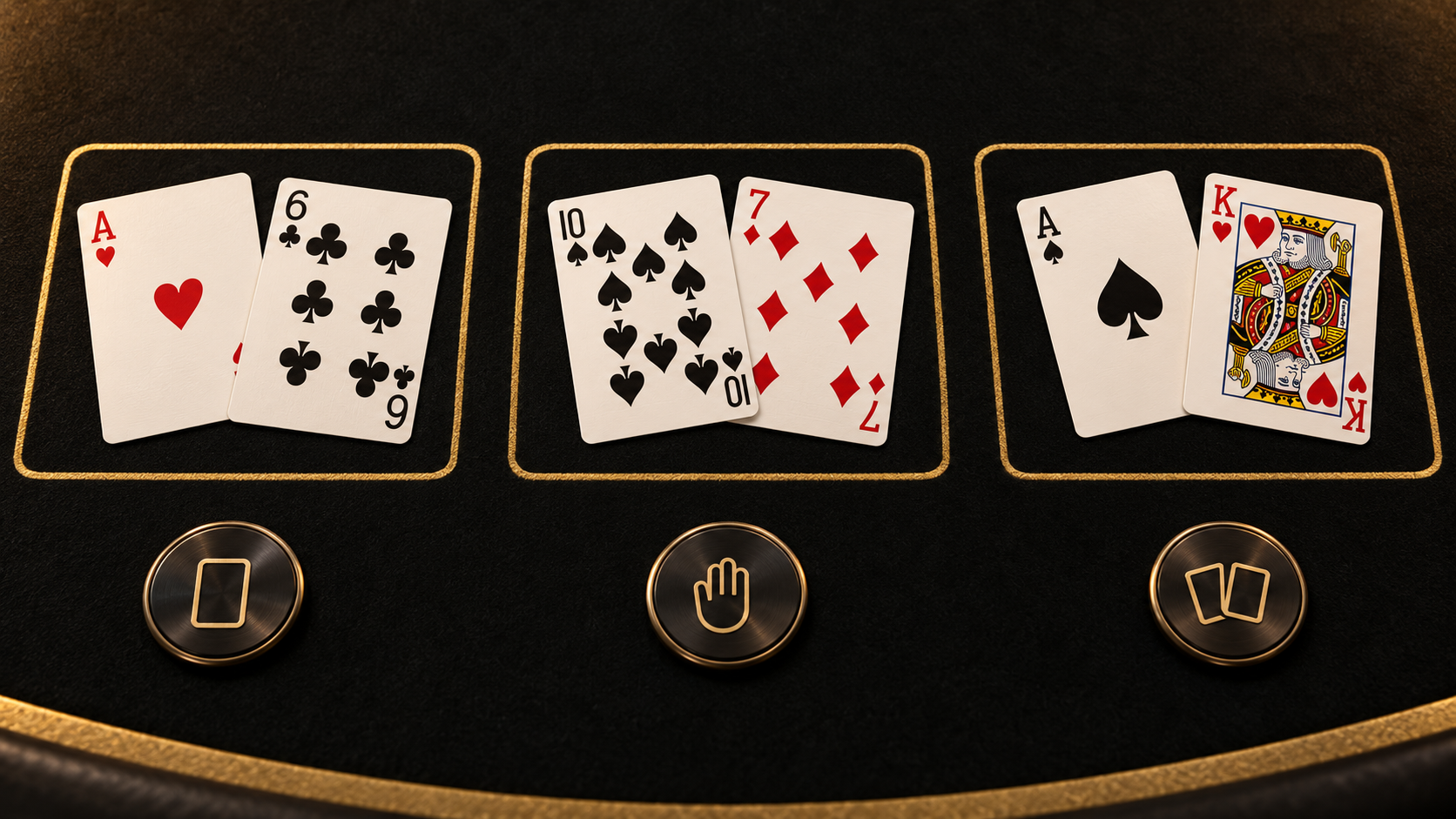
A blackjack soft hand contains an ace that is currently counted as 11 without causing the total to exceed 21.
Examples include:
- Ace + 6 = soft 17
- Ace + 3 = soft 14
- Ace + 2 + 4 = soft 17
- Ace + Ace + 5 = soft 17
The number of cards does not determine whether the hand is soft. What matters is whether an ace can currently count as 11.
Why can a soft total change?
Suppose a hand contains an ace and a 6, producing soft 17. If a 10 is added, counting the ace as 11 would create a total of 27.
The ace therefore counts as 1:
Ace + 6 + 10 = 17
The hand has changed from soft 17 to hard 17. The card itself did not change—the value used for the ace changed under the normal rules.
What Is a Hard Hand in Blackjack?
A blackjack hard hand has no ace that can currently count as 11 without making the total exceed 21.
Examples include:
- 10 + 7 = hard 17
- 8 + 6 = hard 14
- Ace + 6 + 10 = hard 17
- Ace + Ace + 9 + 8 = hard 19
A hard hand can still contain an ace. If every ace must count as 1 to avoid exceeding 21, the total is hard.
“Hard” does not mean the hand will lose, and “soft” does not mean it will win. These terms only describe how the current total is formed.
Soft 17 vs Hard 17
Soft 17 and hard 17 have the same displayed total but different compositions.
- Soft 17: Ace + 6
- Hard 17: 10 + 7
- Hard 17 containing an ace: Ace + 6 + 10
This distinction matters because the dealer’s procedure may treat soft 17 differently from hard 17.
A table can state:
- Dealer stands on soft 17
- Dealer hits on soft 17
These rules are often shortened to S17 and H17.
What Does S17 Mean?
S17 means the dealer stands on soft 17.
If the dealer has an ace and a 6, the dealer does not take another card under an S17 rule.
The dealer does not choose whether to continue based on the player’s hand, previous results or personal judgement. The required action comes from the table’s written procedure.
What Does H17 Mean?
H17 means the dealer hits on soft 17.
With an ace and a 6, the dealer must take another card. The value of the hand is then recalculated.
A hard 17 may still require the dealer to stand under the same rules. Therefore, “dealer hits 17” is an incomplete description. The important question is whether the rule applies specifically to soft 17.
Officially published GameAce Live Blackjack rules illustrate how one blackjack product can support configurations where the dealer either hits or stands on soft 17. The same document also lists configurable split, double-down, surrender and blackjack-payout conditions. genui{“citation”:{“ref”:”turn5view0″}}
Those rules describe that particular product and do not establish the settings of every blackjack table.
What Does Hit Mean in Blackjack?
Hit means requesting another card for the active hand.
After the card is dealt, the hand total is recalculated. Depending on the result, the player may be able to take another action, or the hand may end.
A hit can:
- Increase a hard total
- Change a soft hand into a hard hand
- Produce a total of 21
- Cause the hand to bust
In an online blackjack interface, a visible hit button is not the same as a completed action. Check whether the selection was accepted before the action timer expired.
What Does Stand Mean?
Stand means ending the card-taking decisions for the current hand.
After standing, the hand remains at its current total while the remaining procedure continues. The player normally cannot request another card for that hand.
Standing does not mean the hand has won. The final result still depends on the dealer’s hand and the table’s settlement rules.
What Does Bust Mean?
Bust means that the hand total exceeds 21 after applying the available ace values.
Examples include:
- 10 + 8 + 6 = 24
- King + 5 + 9 = 24
- Ace + 9 + 5 + 8 = 23, with the ace counted as 1
When a player hand busts, it normally loses under conventional blackjack rules, even if the dealer later busts.
However, variants and side wagers can use different conditions. A dealer bust might still determine a separate side-bet result even after the main player hand has been settled.
What Is a Natural Blackjack?
A natural blackjack conventionally consists of:
- One ace
- One 10-value card
- Both received as the original two-card hand
Ten-value cards include:
- 10
- Jack
- Queen
- King
The following are natural blackjacks:
- Ace + King
- Ace + Queen
- Ace + Jack
- Ace + 10
A natural blackjack totals 21, but not every total of 21 is a natural.
Blackjack vs a Regular Total of 21
Consider these hands:
- Ace + King = natural blackjack
- 7 + 6 + 8 = 21, but not a natural
- 5 + 5 + Ace = 21, but not a natural
- Ace + 3 + 7 = 21, but not a natural
The distinction can affect:
- Payout
- Settlement order
- Comparison with the dealer
- Side-bet eligibility
- Treatment after splitting
Do not assume that every displayed total of 21 receives the table’s advertised natural-blackjack payout.
Does 21 After a Split Count as Blackjack?
This depends on the rules, but many blackjack versions treat a two-card 21 after splitting as an ordinary 21 rather than a natural blackjack.
For example, a player splits two aces and receives a king on one of them. That hand contains an ace and a 10-value card, but it was formed after a split rather than as the original two-card hand.
The GameAce rules referenced above explicitly state that a two-card total of 21 after a split counts as 21 and not as a natural blackjack. Other products must be checked individually. genui{“citation”:{“ref”:”turn5view0″}}
What Does Double Down Mean?
Double down normally means adding another stake and receiving a restricted number of additional cards—commonly one.
The exact conditions can vary. A table may permit doubling:
- On any initial two-card hand
- Only on totals of 9, 10 or 11
- Only on totals of 10 or 11
- Before splitting but not afterward
- After splitting
- On some split hands but not split aces
A double-down button does not mean the action is free. It creates an additional financial commitment when accepted.
For example:
- Initial stake: 50 units
- Accepted additional double stake: 50 units
- Total committed to that hand: 100 units
Check the amount shown before confirming the action.
What Does Split Mean?
Split means separating an eligible pair into two hands.
A second stake is normally required for the new hand. Each hand then receives another card and is handled according to the table’s rules.
Important split conditions can include:
- Which pairs are eligible
- Whether equal values or matching ranks are required
- Maximum number of hands
- Whether re-splitting is permitted
- Whether aces can be re-split
- How many cards split aces receive
- Whether doubling after a split is allowed
- Whether 21 after a split counts as blackjack
If a 50-unit opening hand is split with another 50-unit stake, the total committed becomes 100 units before any further permitted actions.
Our guide to live casino table limits and side bets explains how additional decisions can increase the total cost of a round.
What Is a Push?
A push generally means the player’s main hand and dealer’s hand tie under the applicable rules.
The relevant main stake is normally returned. A push is therefore different from a win and different from a loss.
However, a push on the main hand does not automatically return every side wager. Side bets are separate selections and may already have been settled according to their own conditions.
Check the result record rather than assuming that every amount entered on the table receives the same treatment.
What Is Blackjack Insurance?
Insurance is a separate wager that may be offered when the dealer shows an ace.
It normally concerns whether the dealer’s completed hand is a natural blackjack. It is not general protection against every way the player’s main hand might lose.
Important points include:
- Insurance requires an additional stake.
- It is settled separately from the main wager.
- Its maximum can be linked to the main stake.
- The main hand can lose while insurance returns an amount.
- The main hand can win while insurance loses.
Treat insurance as a separate transaction rather than a free safety feature.
What Does Even Money Mean?
Even money may be offered when the player has a natural blackjack while the dealer shows an ace.
The exact operation should be checked in the table rules. Do not assume that every table offers it or that the wording is identical across providers.
The displayed option may interact with the dealer’s possible blackjack and the natural-blackjack payout. Read the settlement description before choosing.
What Is Surrender?
Surrender allows an eligible hand to end under a stated partial-stake settlement.
It is not available on every table, and its timing matters.
Common terms include:
- Early surrender: completed before the dealer checks for blackjack.
- Late surrender: completed after the applicable dealer check.
A table can restrict surrender based on:
- The player’s opening cards
- The dealer’s visible card
- Whether the hand has been split
- Whether another action has already occurred
If the surrender button is unavailable, the option may not exist for that table or the current hand.
What Is a Side Bet in Blackjack?
A blackjack side bet is a separate selection based on a specific event or card combination.
It may use:
- The player’s opening cards
- The dealer’s visible card
- The dealer’s final hand
- A combination of player and dealer cards
- The number or suits of particular cards
Side wagers can be settled before or after the main blackjack hand.
For example, the GameAce rules include side wagers that are evaluated from initial cards and another based on whether—and with how many cards—the dealer busts. genui{“citation”:{“ref”:”turn5view0″}}
The side-bet result does not have to match the main-hand result.
What Does Dealer Upcard Mean?
The dealer upcard is the dealer card visible to the player during the decision stage.
Some blackjack formats also use a face-down dealer card, often called the hole card. Other variants can use different dealing procedures.
The upcard can affect:
- Available player decisions
- Whether insurance is offered
- Dealer-check procedures
- Certain side-bet results
It does not reveal the dealer’s complete final hand.
What Is the Hole Card?
The hole card is a dealer card dealt face down in blackjack formats that use one.
The time when it is checked or revealed depends on the rules. Some formats use a different procedure in which the dealer receives another card later rather than beginning with a concealed card.
This difference can affect how dealer blackjack and additional player stakes are handled. Do not assume that every live table follows the same dealing sequence.
What Does Six-Deck or Eight-Deck Blackjack Mean?
These terms refer to the number of standard card decks used in the table’s card supply.
A six-deck table uses six standard decks, while an eight-deck table uses eight.
Deck count is only one configuration detail. Tables using the same number of decks can still differ in:
- Soft-17 procedure
- Natural-blackjack payout
- Double-down conditions
- Split restrictions
- Surrender availability
- Side wagers
The table name alone is not enough to identify all applicable rules.
What Happens If the Decision Timer Expires?
Online and live dealer blackjack tables normally provide a limited window for player decisions.
If the timer expires, the table may:
- Apply a default action
- Use an automatic decision
- Stand the hand
- Hit under defined conditions
- Follow another procedure stated in the rules
The referenced GameAce product, for example, supports configurable automatic decisions after a player fails to act in time. That does not mean every blackjack table uses the same default. genui{“citation”:{“ref”:”turn5view0″}}
If a connection issue affects the decision window, save the round identifier and check the specific interruption procedure. Our live dealer round guide explains how to separate the video stream from the accepted action and transaction record.
Blackjack Rule Checklist
Before entering a blackjack table, check:
- Number of decks
- Dealer hits or stands on soft 17
- Natural-blackjack payout
- Double-down conditions
- Double after split rule
- Which hands can be split
- Maximum number of splits
- Split-ace restrictions
- Treatment of 21 after a split
- Surrender availability
- Insurance terms
- Side-bet conditions
- Missed-decision procedure
- Minimum and maximum stakes
If any term remains unclear, use the specific table’s information panel rather than relying on a rule remembered from another version.
Final Takeaway
Blackjack terminology describes how hands, decisions and settlements work. Soft and hard refer to how an ace is valued. A natural blackjack is an original two-card hand, not simply any total of 21. Split, double, insurance and side bets can each add another stake.
Understanding these terms makes it easier to read the table’s rules and review a completed round accurately. It does not guarantee a winning result or remove the financial risk of wagering.