

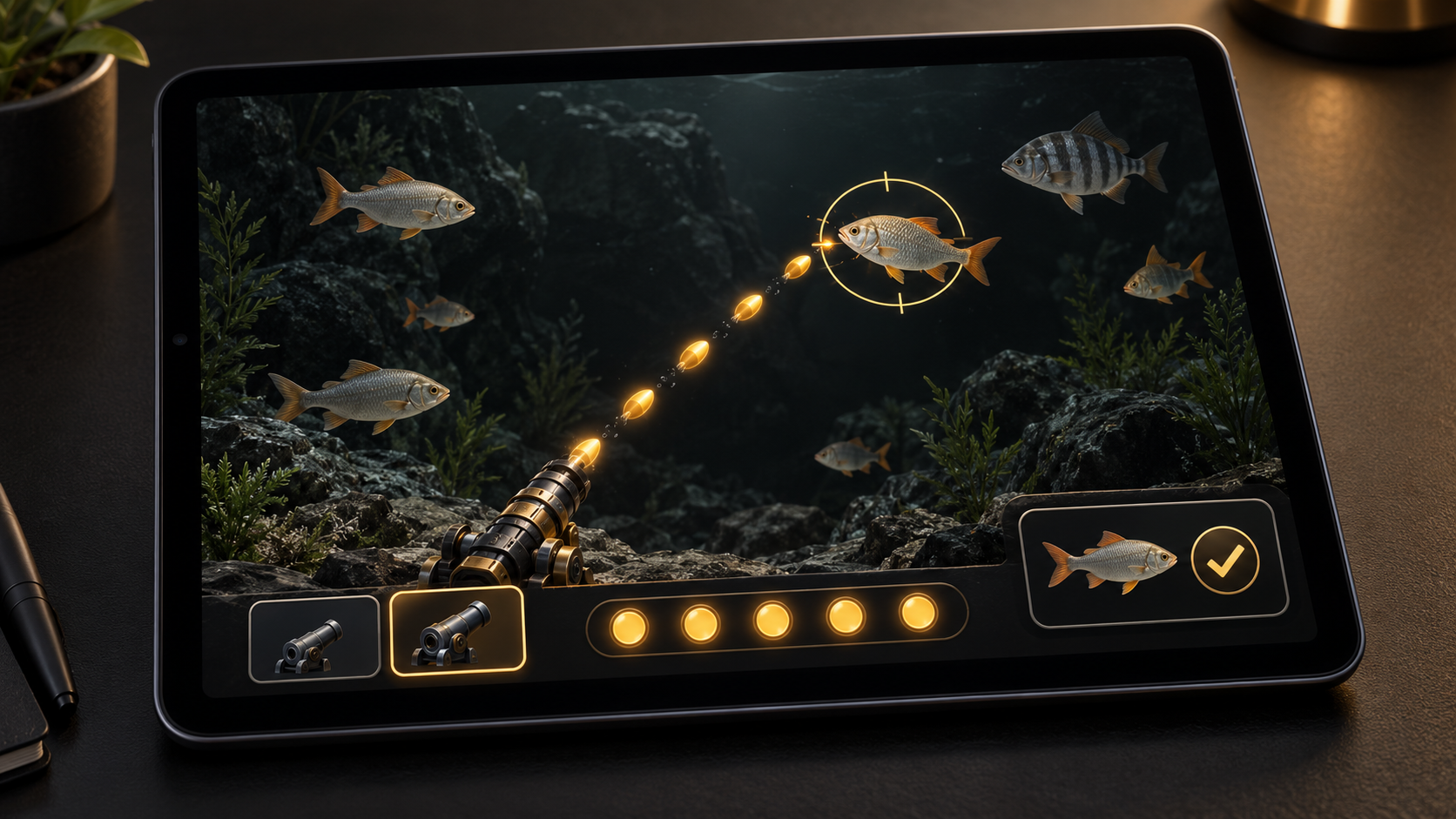
Online fishing games normally place moving targets on a shared underwater screen and allow players to fire using a cannon or similar control. Their visual style resembles an arcade game, but every charged action can affect a real or credit-based balance.
To understand a fishing title properly, you need to know what one shot costs, whether changing the cannon level changes that cost, how a credited capture is determined and what the displayed multiplier applies to.
This guide explains the financial and interface terms commonly found in online fishing games. Fishing titles differ significantly, so the examples below are hypothetical. The selected game’s rules remain the source for its actual costs, eligible targets and settlement conditions.
What Is an Online Fishing Game?
An online fishing game is an arcade-style format in which targets move across the screen while one or more players fire projectiles from a cannon.
Depending on the title, the screen may include:
- Ordinary fish
- Larger targets or bosses
- Special weapons
- Energy meters
- Target-lock controls
- Automatic firing
- Multipliers
- Shared events
- Additional reward stages
Although the interface is presented like an arcade experience, the balance can decrease every time the game records a paid action.
The first question should therefore be: How much does one shot cost?
Start With the Cost of One Shot
Look at the amount displayed beside the cannon, firing button or power control. This number may represent:
- Currency per shot
- Credits per shot
- Cannon power
- Ammunition level
- Bet level
- A multiplier setting
These terms are not automatically equivalent. A cannon marked “10” does not necessarily mean that exactly 10 units of account currency will be deducted.
Check the rules for the relationship between:
- Selected cannon level
- Credit value
- Currency conversion
- Amount deducted per action
- Eligible target return
Basic shot-cost example
Suppose one charged shot costs 2 units.
If the game records 10 shots:
2 units × 10 shots = 20 units staked
If it records 50 shots:
2 units × 50 shots = 100 units staked
The relevant cost comes from the number of charged actions, not simply the time spent on the screen.
Holding the Fire Button Can Create Multiple Charges
Some fish shooting games allow continuous firing while the control is held down.
What feels like one continuous press may produce many separate shots. If each shot carries a charge, every recorded projectile adds another stake.
For example:
- Cost per shot: 2 units
- Firing rate: 5 charged shots per second
- Button held for 6 seconds
- Total shots: 30
- Total stake: 60 units
The exact firing rate and cost depend on the title. This example only illustrates why a low amount per action can create a much larger total quickly.
Do not treat one press-and-hold gesture as one financial transaction unless the game rules clearly say so.
Does Increasing Cannon Power Increase the Cost?
Often, a cannon-level or power adjustment changes the amount committed per shot. However, the exact effect must be checked in the rules.
A higher level can potentially change:
- Cost per projectile
- Eligible target multiplier
- Displayed award
- Weapon appearance
- Feature interaction
- Ammunition type
A larger projectile animation does not provide a mathematical explanation of those changes.
Cannon-level example
Assume a title offers two hypothetical settings:
| Cannon setting | Cost per shot | Cost of 20 shots |
|---|---|---|
| Lower setting | 2 units | 40 units |
| Higher setting | 10 units | 200 units |
The higher setting creates five times the total stake over the same number of actions.
This does not prove that it produces a better financial result. Both the potential return and the amount spent may become larger.
Separate Cannon Power From Capture Probability
Players sometimes assume that increasing the cannon level guarantees a faster or more valuable capture.
That conclusion should not be made unless the rules clearly explain the relationship.
The cannon level might affect the amount staked and the return calculation without disclosing an exact probability. It may also interact with a title-specific feature.
Ask these questions separately:
- How much does the selected level cost?
- What value is used to calculate a credited return?
- Does the rule state that the setting affects capture probability?
- Does it affect only certain targets or weapons?
- Does it change when a feature begins?
If the probability is not disclosed, do not replace the missing information with an estimate based on a few observed results.
A Visual Hit Is Not Always a Credited Capture
A projectile can appear to touch a target without creating an awarded result.
Fishing interfaces can be visually busy. Several players may be firing at the same area while targets overlap, move or disappear.
The game’s recorded outcome—not visual proximity alone—determines whether an award was credited.
Check for:
- A confirmed capture animation
- A return credited to your position
- An individual result display
- A change in your game balance
- A session or transaction record
- Attribution to your cannon or player position
A target disappearing does not automatically prove that your projectile received the associated return. Another player may have received it, or the disappearance may be part of a feature animation.
Shared Screens Can Make Attribution Difficult
Some online fishing games display several cannons around the same shared scene.
When multiple players fire at one target, it may be difficult to identify who received the result by watching the animation alone.
Avoid relying on:
- Which projectile looked closest
- Which cannon appeared to fire last
- The direction in which the target moved
- The size of another player’s animation
- A brief visual effect near your position
Use the personal balance, award indicator or transaction record where available.
If the attribution remains unclear, save:
- The session identifier
- Approximate time
- Player position
- Selected cannon level
- Target involved
- Opening and closing balances
- A screenshot or screen recording
How Do Fishing Game Multipliers Work?
A target might display a multiplier such as 20×, but the multiplier requires a defined base.
It could apply to:
- The selected shot cost
- The projectile that received the capture
- A qualifying cannon level
- A feature stake
- A fixed credit amount
- Another value stated in the rules
Before calculating the return, determine what the multiplier multiplies.
Multiplier example
Suppose:
- Eligible shot cost: 2 units
- Credited target multiplier: 20×
- The rules state that the multiplier applies to the eligible shot cost
The resulting return would be:
2 × 20 = 40 units
That calculation describes the credited target. It does not yet show whether the entire sequence was profitable.
Include Every Earlier Shot When Calculating the Net Result
Suppose a player fires 25 shots costing 2 units each before receiving the 40-unit return described above.
The complete calculation is:
- Total shot costs: 25 × 2 = 50 units
- Total return: 40 units
- Net result: 40 − 50 = −10 units
The capture produced a positive return, but the recorded sequence still ended with a 10-unit net loss.
A highlighted multiplier should not be confused with the overall financial result.
Use the same method explained in our guide to live casino table limits and total stakes: add every amount committed, add every amount returned and compare the totals.
Fixed, Variable and Maximum Values
A number displayed on a target can have several possible meanings.
It might represent:
- A fixed multiplier
- A multiplier range
- A possible maximum
- A feature value
- A randomly selected result
- A value before another condition is applied
For example, a target displaying “up to” a particular multiplier does not guarantee that the maximum will be awarded on every qualifying result.
Check whether the rules describe the value as:
- Fixed
- Variable
- Maximum
- Progressive
- Feature-dependent
- Selected from a range
Do not treat promotional artwork as a complete paytable.
Special Weapons and Energy Meters
Fishing arcade games can include special weapons or energy systems.
Possible features include:
- Full-screen attacks
- Lasers
- Bombs
- Target-locking weapons
- Area attacks
- Temporary enhanced cannons
- Boss stages
- Multiplier wheels
Every feature should be examined separately.
Check:
- What fills or triggers the feature?
- Does firing while charging it still cost money?
- Does activating it create another charge?
- Which targets are eligible?
- What stake determines its return?
- How long does the feature last?
- Does unused energy carry into another session?
- When does the meter reset?
A full meter does not by itself explain what will happen next.
Example of a Title-Specific Feature
JILI’s official description of Royal Fishing provides an example of mechanics that belong to one specific title. It describes bullets accumulating energy toward a full-screen attack, along with boss choices and a Money Dragon King multiplier-wheel feature. genui{“citation”:{“ref”:”turn6view0″}}
This description illustrates why fishing features must be checked by title. It does not establish the cost, probability, return or availability of that game on ChokD99.
Another fishing title may use completely different:
- Cannon rules
- Energy conditions
- Target multipliers
- Boss mechanics
- Feature durations
- Award calculations
Do not transfer rules from one title to another merely because both use an underwater shooting theme.
Boss Targets Need Their Own Rules
Large or visually important targets are often described as bosses.
A boss can have:
- A special multiplier
- A separate feature
- A shared event
- An award range
- A required weapon
- A time limit
- A randomly selected value
The size of the target does not tell you how likely it is to produce a credited result.
Before focusing on a boss, determine:
- Whether ordinary shots can qualify
- Whether a feature is required
- Which cannon level determines the return
- Whether several players can contribute
- How attribution is decided
- Whether the displayed value is fixed or variable
Automatic Firing and Target Lock
Some fish shooting games provide automatic or repeated-firing controls.
Before activating them, check:
- How auto-fire begins
- How it stops
- Whether it continues when a target disappears
- Whether the cannon level remains fixed
- Whether every projectile is charged
- Whether the target-lock feature changes the cost
- Whether an inactivity or balance condition stops it
Automatic controls can make it harder to notice how quickly paid actions are accumulating.
You should not need to activate the function merely to discover its cost. Look for the instructions first.
A Small Per-Shot Amount Can Accumulate Quickly
Low individual costs can appear insignificant while rapid firing produces a much larger cumulative stake.
Consider a hypothetical one-unit shot repeated 100 times:
1 unit × 100 actions = 100 units staked
At five units per shot:
5 units × 100 actions = 500 units staked
The screen speed and colourful animation do not change this arithmetic.
A useful interface should keep the selected shot cost and current balance visible while repeated actions occur.
Credits, Scores and Currency Are Different Concepts
A fishing game may show several balances or totals:
- Arcade score
- Game credits
- Account currency
- Session return
- Feature points
- Energy
- Main-wallet balance
- Game-wallet balance
These values should not be treated as interchangeable unless the rules explicitly connect them.
A large score does not prove that the same amount is available for withdrawal.
Check:
- Which value represents money
- The conversion between currency and credits
- Where returns are credited
- Whether the game uses a separate wallet
- How money moves back to the main account
Game-Wallet Transfers Are Not Automatically Losses
Some platforms move funds from a main account into a separate game wallet.
For example:
- Main wallet before transfer: 1,000 units
- Transfer to fishing wallet: 200 units
- Main wallet after transfer: 800 units
- Fishing wallet after transfer: 200 units
At this stage, the total remains 1,000 units. The money has moved between wallets but has not necessarily been lost through paid actions.
To calculate the gambling result, separate:
- Wallet transfers
- Charged shots
- Credited returns
- Manual adjustments
- Pending transactions
- Closing balances
Our casino account and wagering guide explains the difference between transfers, stakes and returns.
How to Review a Fishing Session
A useful session record should include:
- Opening game balance
- Currency or credit unit
- Selected cannon level
- Cost per shot
- Number of charged shots
- Total amount staked
- Captures credited
- Total amount returned
- Wallet transfers
- Closing game balance
- Session identifier
Session example
Suppose the record shows:
- Opening game balance: 500 units
- Charged actions: 60 units
- Credited returns: 25 units
- No transfers or adjustments
The expected closing balance is:
500 − 60 + 25 = 465 units
The net result is:
25 − 60 = −35 units
Keep score values separate unless they have a stated conversion into the same financial unit.
What If Detailed Shot History Is Unavailable?
Some titles may not provide a visible entry for every projectile.
If the balance appears inconsistent, request:
- Session statement
- Opening and closing balances
- Total actions charged
- Total returns credited
- Wallet transfers
- Pending or adjusted entries
- Relevant feature results
Do not estimate the number of shots solely from animation speed. Lag, repeated firing and overlapping effects can make that count unreliable.
Common Unsupported Fishing Game Claims
Treat these claims cautiously unless supported by the exact game’s rules and reliable evidence:
- A particular target is due to be captured.
- A boss becomes easier after many failed shots.
- Another player’s spending guarantees your next result.
- A particular firing rhythm always produces a return.
- A target moving in one direction is more valuable.
- Changing cannon levels at a certain moment guarantees a capture.
- A crowded screen means the game is ready to pay.
Selected clips show what happened in one short sequence. They do not establish a universal prediction method.
The same reasoning applies to the pattern claims discussed in our guide to independent random results.
Online Fishing Game Checklist
Before using an online fishing title, confirm:
- What does one shot cost?
- Is the amount shown in currency or credits?
- Does holding the button create repeated charges?
- Does changing cannon level change the cost?
- What does the target multiplier apply to?
- How is a credited capture shown?
- How are shared-screen results attributed?
- Do special weapons add a charge?
- How do energy meters reset?
- Are values fixed, variable or maximums?
- Where are returns credited?
- Is a separate game wallet used?
- Is session history available?
If a key cost or conversion remains unclear, resolve it before entering repeated paid actions.
Final Takeaway
Online fishing games combine arcade-style controls with repeated financial actions. The most important information is the cost of one shot, the number of actions recorded, the multiplier base and the location of credited returns.
A visually successful capture does not automatically mean the complete session was profitable. Calculate the result by adding every charged action and comparing the total with all credited returns.
Clear costs, understandable credit units and usable session records help explain what occurred. They do not create a guaranteed method for capturing a target or earning a profit.